The Vanishing Entry Point: How AI is Reshaping the Project Management Career Ladder
What the ‘End of Junior Positions’ Means for PM Teams and the Next Generation of Talent
For decades, the pathway into project management followed a predictable trajectory. Fresh graduates and career changers entered as junior coordinators, spending years mastering status reports, updating Gantt charts, and organizing stakeholder meetings. These foundational roles served a dual purpose: they kept projects running smoothly while providing essential training ground for future leaders.
That pathway is rapidly disappearing.
A recent industry report from cplace warns of a “fundamental realignment” in project teams, driven by AI’s ability to automate the very tasks that once defined junior PM roles. For project managers and scrum masters leading teams today, this shift demands urgent attention—not just to how we structure our teams, but to how we cultivate the leaders of tomorrow.
The Administrative Core: What AI is Replacing
The transformation is already underway in organizations across industries. AI systems now perform tasks that once consumed 60-80% of a junior project manager’s workday:
Project Plan Updates and Maintenance: AI tools continuously sync data from multiple sources, automatically adjusting timelines, flagging dependencies, and updating resource allocations. What once required manual reconciliation across spreadsheets and project management platforms now happens in real-time without human intervention.
Status Reporting and Documentation: Natural language processing algorithms scan team communications, code commits, and task completions to generate comprehensive status reports. These AI-authored updates often surpass human-written versions in accuracy and timeliness, pulling directly from source systems rather than relying on potentially outdated manual inputs.
Meeting Coordination and Follow-up: Intelligent scheduling assistants negotiate availability across calendars, send reminders, transcribe discussions, extract action items, and track completion—all without a junior PM spending hours on email threads and calendar management.
Basic Risk and Issue Tracking: Machine learning models analyze patterns across thousands of similar projects to identify potential risks before they manifest, automatically categorizing and prioritizing issues based on historical impact data.
The efficiency gains are undeniable. A single AI system can manage administrative tasks across multiple concurrent projects with greater consistency and fewer errors than a team of junior coordinators. But this efficiency comes with a hidden cost: the elimination of the very experiences that built project management expertise.
The Skills Paradox: What Junior Roles Actually Taught Us
To understand what’s being lost, we need to look beyond the surface-level tasks. Junior PM roles weren’t valuable because updating project plans is complex—they were valuable because of what practitioners learned while updating those plans.
Pattern Recognition Through Repetition: Manually tracking task dependencies taught emerging PMs to instinctively recognize when delays in one area would cascade elsewhere. AI can flag these dependencies, but it can’t transfer the intuition that develops from repeatedly tracing impact chains through a project’s ecosystem.
Stakeholder Relationship Building: The weekly ritual of gathering status updates meant junior PMs had regular touchpoints with every team member. These weren’t just transactional exchanges—they built the relationships and trust that enable senior PMs to navigate political complexity and drive consensus. AI-generated reports eliminate these interaction points entirely.
Communication Calibration: Writing status reports taught emerging PMs how to distill complexity for different audiences, which details matter to executives versus technical leads, and how to frame challenges constructively. This communication muscle develops through practice and feedback—experience now bypassed when AI handles the writing.
Project Ecosystem Understanding: Coordinating meetings exposed junior PMs to how different organizational functions interact, where authority truly lies versus what the org chart suggests, and which conflicts consistently emerge. This systems thinking doesn’t come from observing—it comes from being immersed in the messy reality of making things happen.
We’re creating a skills paradox: organizations need senior PMs who possess these hard-won competencies, but we’re eliminating the developmental pathway that created them.
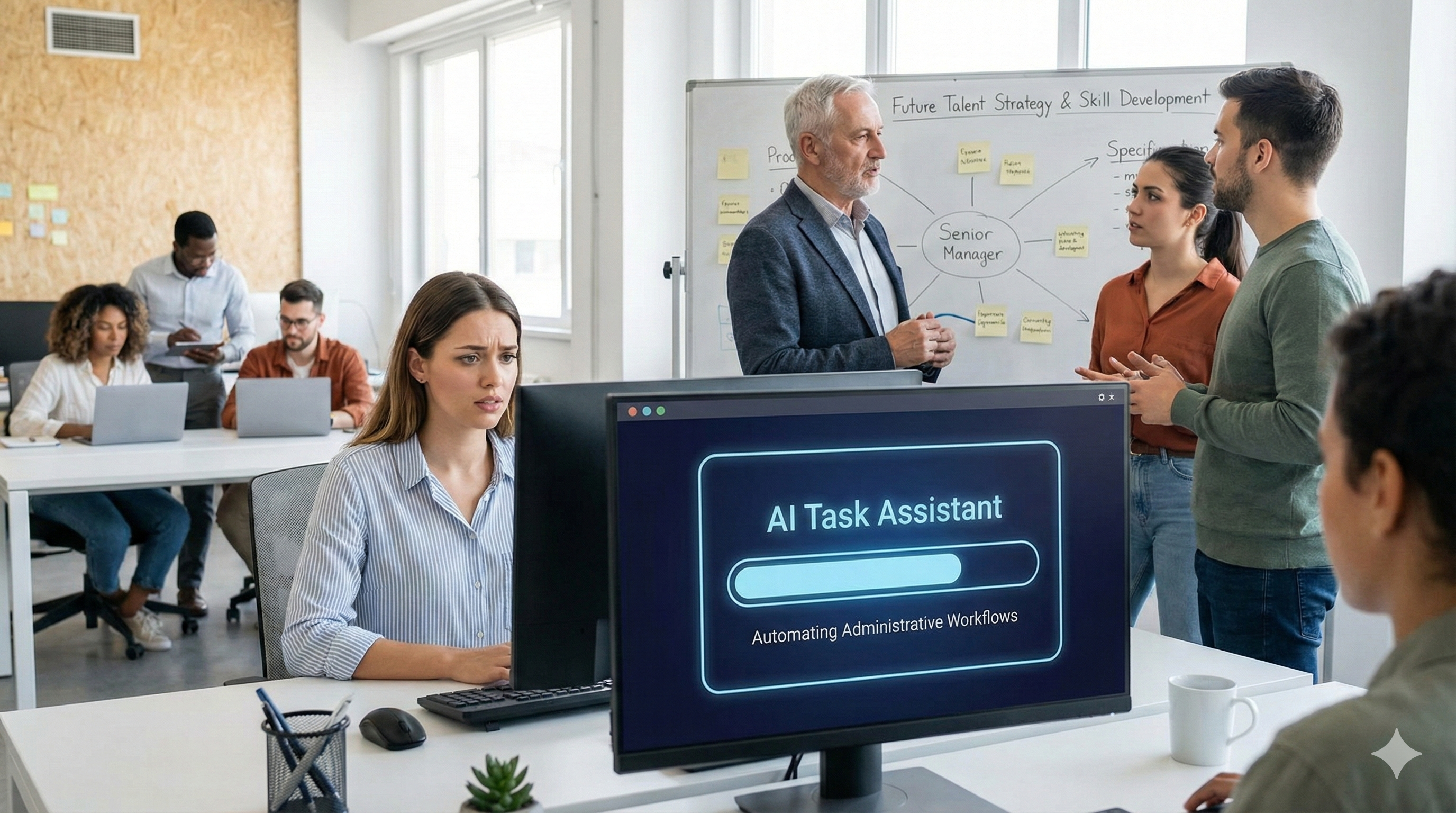
The Market Shift: What Organizations Are Really Seeking
The cplace report identifies a clear trend: organizations are increasingly seeking senior project managers while entry-level requisitions decline. This isn’t just about headcount efficiency—it reflects a fundamental shift in what project management roles demand.
With AI handling operational execution, the remaining human roles center on capabilities machines can’t replicate:
Strategic Ambiguity Navigation: When project goals are unclear or competing, when stakeholders have conflicting priorities, or when the path forward is genuinely uncertain, organizations need PMs who can navigate complexity through judgment, influence, and creative problem-solving—not algorithmic optimization.
Change Leadership: Projects fail more often from resistance than from poor planning. Senior PMs understand how to read organizational dynamics, build coalitions, manage political landmines, and guide teams through discomfort. These deeply human skills remain firmly outside AI’s capabilities.
Contextual Decision-Making: AI excels at optimization within defined parameters but struggles when business context should override standard processes. Experienced PMs know when to follow the playbook and when violating it serves the project’s true objectives.
Innovation Facilitation: The most valuable projects often emerge from recognizing possibilities others miss. Senior PMs create environments where innovation flourishes—connecting disparate ideas, giving teams permission to experiment, and identifying when to pivot strategies.
These capabilities require years of accumulated wisdom, not just technical proficiency. But how do aspiring PMs acquire this wisdom when the traditional learning pathway has been automated away?
The Talent Pipeline Crisis: Where Do Future Leaders Come From?
The hollowing out of junior positions creates a looming talent crisis. Organizations pursuing short-term efficiency by eliminating entry-level roles are unknowingly sabotaging their long-term leadership pipeline.
Consider the mathematics: if it traditionally took 5-7 years to develop a senior PM through progressively complex roles, and we’ve just eliminated the first 2-3 years of that journey, where will qualified senior candidates come from in 2030?
Some argue the market will self-correct—that aspiring PMs will find alternative development paths, perhaps in consulting, product management, or technical roles. But this assumes these adjacent fields won’t undergo similar AI-driven transformations. Moreover, it doesn’t address the near-term gap.
For scrum masters and agile coaches, this challenge is particularly acute. Agile methodologies rely on servant leadership, team facilitation, and psychological safety—competencies developed through practice, not automation. How do we cultivate these skills in an environment where AI handles the tactical work that once provided practice opportunities?
Reimagining PM Development: A Path Forward
The solution isn’t to resist AI adoption—the efficiency gains are too significant and the competitive pressures too intense. Instead, we must deliberately redesign how we develop project management talent in an AI-augmented world.
Structured Rotation Programs: Rather than parking junior talent in administrative roles, create rotation programs that expose them to different project types, organizational contexts, and leadership challenges. If AI handles execution, use the freed capacity to provide broader developmental experiences earlier in careers.
AI Collaboration Skills as Core Competency: Teach emerging PMs to work with AI rather than being replaced by it. This means understanding AI’s capabilities and limitations, knowing when to override algorithmic recommendations, and using AI-generated insights as inputs to human judgment rather than final decisions.
Apprenticeship Model Renaissance: Pair junior PMs with experienced leaders for extended periods, focusing on decision-making processes rather than task completion. The goal is knowledge transfer and judgment development—watching how senior PMs think through complexity, not just what they deliver.
Simulated Complexity Training: Develop intensive simulation environments where emerging PMs face compressed versions of the challenges they’d typically encounter over years. Think flight simulators for project management—safe spaces to develop pattern recognition and decision-making skills rapidly.
Redefine ‘Junior’ Responsibilities: If administrative work is automated, what should entry-level PMs focus on? Perhaps facilitating retrospectives, conducting stakeholder interviews, or leading process improvement initiatives—activities that build strategic skills while contributing immediate value.
Cross-Functional Experience Requirements: Require emerging PMs to spend time embedded with engineering, design, marketing, or operations teams. Understanding how different functions think and operate is foundational to senior PM effectiveness and can’t be learned from AI-generated reports.
What This Means for Your Team Today
For project managers and scrum masters leading teams right now, this shift requires immediate action:
Audit your current team structure. How many roles are primarily administrative? What happens to team capability when these roles are automated? Start planning the transition now rather than reacting to budget pressures later.
Invest in your junior talent deliberately. Don’t wait for formal programs. Create opportunities for emerging PMs to observe complex negotiations, participate in strategic planning, and receive mentorship on judgment-intensive decisions. Make their development intentional rather than hoping experience accumulates organically.
Rethink your hiring criteria. If you’re hiring for strategic capabilities but evaluating candidates based on administrative competencies, you’re optimizing for a world that no longer exists. Assess for adaptability, systems thinking, and collaboration over tool proficiency and process knowledge.
Advocate for industry-wide solutions. Individual organizations can’t solve the talent pipeline crisis alone. Engage with professional associations, certification bodies, and academic institutions to redesign PM education and credentialing for the AI era. The problem is collective; the solution must be too.
The Opportunity in the Crisis
The end of junior positions as we’ve known them is undoubtedly disruptive. But disruption often forces long-overdue improvements.
Perhaps we’ve relied too heavily on administrative work as a training mechanism because it was convenient, not because it was optimal. Maybe there are better, faster ways to develop the strategic capabilities organizations truly need—approaches that were impractical when junior PMs were consumed by operational tasks.
The organizations that thrive won’t be those that resist AI adoption or those that blindly automate without considering human development. The winners will be those that harness AI’s efficiency while deliberately cultivating the uniquely human capabilities that make great project leaders.
For project managers and scrum masters, this is your moment to shape what comes next. The pathway into our profession is being rewritten—we can either watch it happen or actively design the future we want to see.
The question isn’t whether the traditional junior PM role survives. It won’t. The question is: what will we build in its place?