The Silicon Workforce Has Arrived: Are You Ready for Your New AI Coworkers?
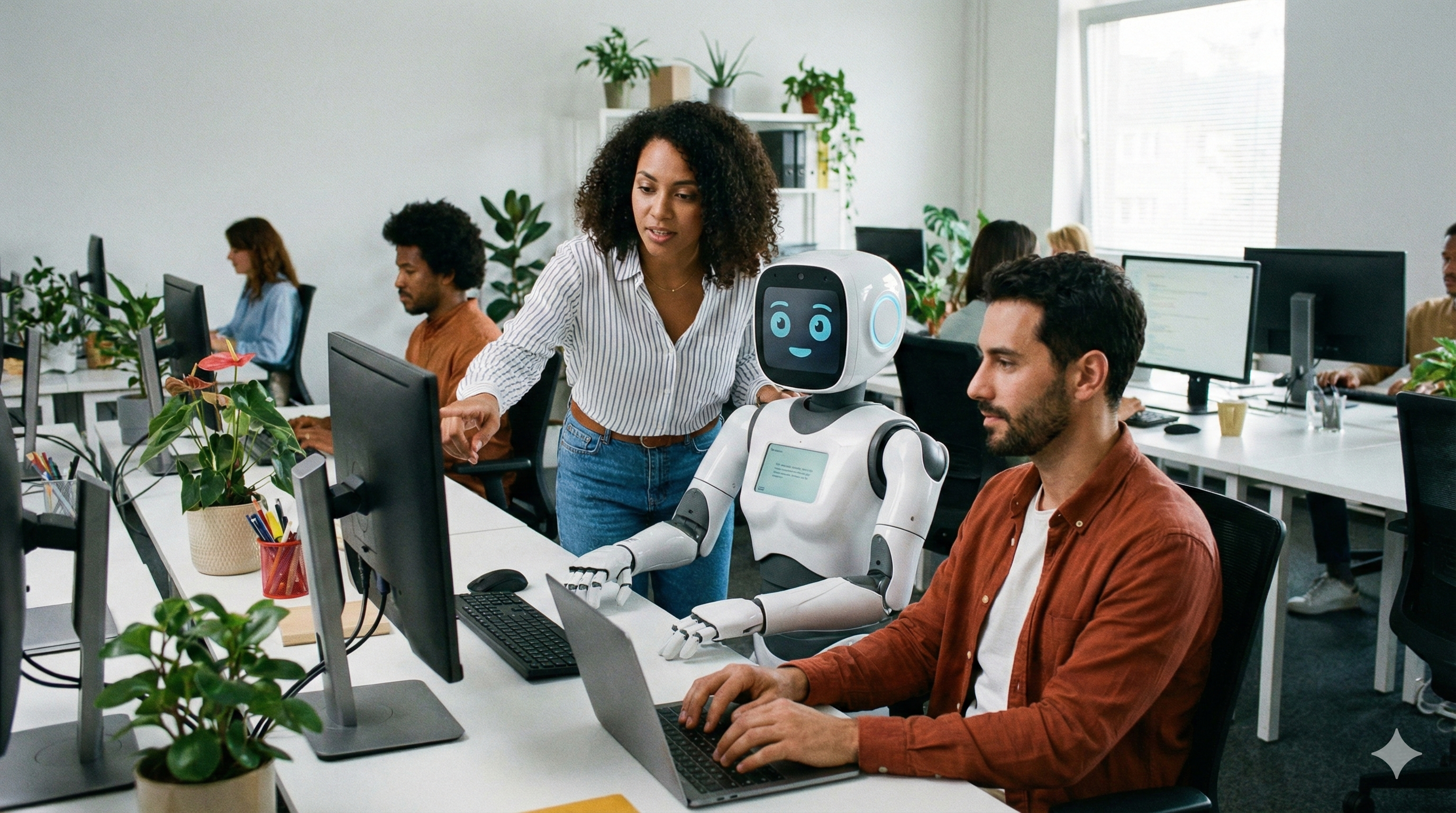
The year is 2026, and the future of work is no longer a distant forecast—it's the new reality. Industry bodies like the Association for Project Management (APM) have officially declared this the year of the Hybrid Human-AI Workforce . But what does this mean for your team, your career, and your organization? We've moved beyond the era of simple chatbots and into the age of Agentic AI: autonomous systems capable of managing entire workflows, from planning and resource allocation to risk mitigation .
This isn't just another tech trend; it's a fundamental shift in how we work. For Agile teams, this means a transition from managing people to orchestrating a symphony of human and digital talent. Project managers are evolving into "AI Directors," overseeing a new "silicon workforce" that handles the hyper-automation of routine tasks, freeing up their human counterparts for more strategic, creative, and complex problem-solving.
The New Reality: From Chatbots to Autonomous Agents
The leap from chatbots to agentic AI is significant. While chatbots are designed for reactive, conversational tasks, agentic AI systems are proactive and goal-oriented. As detailed in a recent Trew Knowledge report, platforms like OpenAI's Frontier are enabling enterprises to deploy agents across entire organizations, connecting siloed data and empowering these digital workers to reason over information, use tools, and execute complex workflows .
We're already seeing the tangible impact of this shift. A manufacturing firm reduced its production optimization timeline from six weeks to a single day, an investment company freed up over 90% of its salespeople's time, and an energy producer increased its output by 5%, translating to over a billion dollars in additional revenue . These are not marginal gains; they are transformative results driven by the strategic deployment of a silicon workforce.
The Human-AI Partnership: A New Organizational Model
The rise of the silicon workforce necessitates a new organizational model centered on human-AI collaboration. According to a recent report from Boston Consulting Group (BCG), the most significant barriers to AI adoption are not technological but organizational, falling squarely within the domain of HR . The report emphasizes a "10/20/70 rule" for AI value creation: 10% - Algorithms, 20% - Technology and data infrastructure, 70% - Transformation of people, organization, and processes.
This underscores a critical point: AI transformation doesn't live in the IT department; it lives in the redesign of work, roles, and culture . As project managers become AI Directors, their focus shifts from task management to strategic orchestration, ensuring that human and AI efforts are aligned and optimized.
The Reality Check: Navigating the Adoption Gap
Despite the immense potential, the transition to a hybrid workforce is not without its challenges. A Deloitte report reveals a significant gap between hype and reality, with only 11% of organizations having AI agents in production . Another 38% are in the pilot phase, while a surprising 35% have no agentic strategy at all .
Performance is another hurdle. Even top-tier AI models succeed in completing real-world tasks less than 25% of the time on the first attempt . Furthermore, critical issues of liability, governance, and security remain significant barriers to widespread adoption. As one report notes, professionals in high-stakes fields like law and medicine remain cautious, as they are personally liable for outcomes, and a single AI error can be scaled across an entire organization with disastrous consequences .
The Path Forward: A Two-Speed Agenda for the Hybrid Workforce
To navigate this complex transition, organizations must adopt a two-speed agenda. As outlined by BCG, this involves simultaneously strengthening the fundamentals of HR and data systems while embracing a forward-looking ambition to redesign roles and operating models for an AI-first environment .
The APM echoes this sentiment, emphasizing that while AI can process vast amounts of data to identify patterns and risks that humans might miss, it is the project manager who provides the experience, context, and judgment to interpret those results in the real world . The future of project management, and indeed all knowledge work, lies in this powerful combination of human insight and digital intelligence.
Conclusion: Your New Coworkers Are Here
The silicon workforce is no longer a futuristic concept. It's here, and it's reshaping the world of work in profound ways. The transition to a hybrid human-AI workforce presents both immense opportunities and significant challenges. By understanding the new reality of agentic AI, embracing the human-AI partnership, and navigating the adoption gap with a strategic, two-speed approach, organizations can unlock the transformative potential of their new digital coworkers and thrive in the age of the silicon workforce.