The Intelligence Shift: How AI Is Rewriting the Rules of Project Management in 2026
Project management has always been an exercise in orchestrating complexity — balancing competing priorities, managing human dynamics, and keeping deliverables on track against the relentless pressure of time and budget. But in March 2026, the discipline finds itself at a profound inflection point. The integration of artificial intelligence into the project management stack has accelerated far beyond chatbots and basic automation. Four major forces are reshaping how projects are conceived, staffed, governed, and executed. Understanding these trends is not optional for today's project leaders — it is existential.
"AI is no longer a tool that project managers use. In many organizations, it has become a project manager in its own right."
🤖 Agentic Autonomy — Now Mainstream
STATUS: MAINSTREAM
If there was a single headline from Q1 2026 in project management circles, it is this: AI "super agents" have gone fully mainstream. These are not the narrow-purpose bots of years past that could only answer FAQs or fill in status fields. Today's super agents are sophisticated, autonomous systems capable of triaging incoming requests, routing tasks to the right team members, firing off status-check emails, scheduling stakeholder calls, and even flagging scope creep — all without a single human input. They operate around the clock, seven days a week, ensuring that no communication falls through the cracks regardless of time zone or business hours.
The implications for project management teams are significant and, for some, unsettling. Organizations that have deployed agentic AI report reducing administrative overhead by as much as 40%, freeing project managers to focus on higher-value strategic work. At the same time, questions around accountability, bias, and error correction have surged to the forefront. When an AI agent makes a poor triage decision or sends an ill-timed message to a client, the chain of human responsibility becomes blurry. Industry bodies are actively working on updated governance frameworks to address these gaps, but for now, the agents are running — and organizations are learning on the fly.
The mainstream adoption of agentic autonomy has also reshuffled team structures. Roles that were once primarily administrative — meeting coordination, status reporting, document management — are being absorbed or heavily augmented by AI. The project managers who are thriving in this environment are those who have repositioned themselves as AI orchestrators: people who define the rules, monitor the outputs, and intervene when the machine gets it wrong.
⚖️ Tactical Governance — A Critical Imperative
STATUS: CRITICAL
As AI becomes a decision-maker within project workflows, the need for rigorous tactical governance has become nothing short of critical. This is not governance in the traditional, bureaucratic sense — it is something more dynamic, more contextual, and more urgent. The new wave of AI-powered platforms, exemplified by tools like Storyflow's embedded expert Tactics engine, are positioning AI not merely as a task executor but as a methodology coach — a real-time advisor that nudges teams toward best practices, flags deviations from agreed-upon ways of working, and provides on-demand guidance on frameworks like Agile, PRINCE2, or hybrid approaches.
The stakes here are genuinely high. When AI is coaching teams on methodology, the quality and accuracy of that coaching has direct downstream effects on project outcomes. Organizations that have deployed AI methodology coaches report measurable improvements in team adherence to process — but they have also encountered uncomfortable edge cases. What happens when the AI's interpretation of "Agile best practice" conflicts with the judgment of a seasoned project director? Whose guidance takes precedence? These are not abstract philosophical questions; they are practical disputes that are now landing on the desks of PMOs and governance committees every week.
The criticality designation assigned to this trend reflects the urgency with which the industry needs to resolve these tensions. Boards and executive teams are increasingly demanding traceability — they want to know not just what decisions were made on a project, but why, and whether AI played a role in shaping them. Tactical governance frameworks that can provide this level of auditability are in desperately short supply, and the organizations that invest in developing them now will have a significant competitive advantage as regulatory scrutiny of AI decision-making intensifies.
"The organizations winning with AI governance are treating it like a living system — one that evolves as their AI capabilities evolve."
🏗️ Infrastructure Generation (GenOps) — An Emerging Frontier
STATUS: EMERGING
Perhaps the most intellectually provocative development in the March 2026 landscape is what practitioners are beginning to call GenOps — the use of generative AI not merely within project management systems, but to build those systems themselves. This is AI eating its own tail in the most productive possible way. Rather than implementing pre-packaged project management tools and adapting workflows to fit the software, forward-thinking organizations are now using large language models and generative pipelines to synthesize bespoke project management infrastructure tailored precisely to their operational context.
In practical terms, this might mean using AI to auto-generate a custom Kanban configuration for a new product line, or to scaffold an entire PMO operating model from a high-level strategic brief. Early adopters in financial services, pharmaceuticals, and defense contracting — industries with highly specific compliance and workflow requirements — are reporting that GenOps approaches can compress the time-to-operational-readiness for new project structures from months to days. The ability to describe what you need in natural language and receive a functioning, configurable project management system in return represents a genuinely disruptive shift in how operational infrastructure is conceived.
That said, GenOps remains firmly in the "emerging" category, and for good reason. The AI-generated systems are only as good as the prompts, data, and constraints fed into them. There are real risks of generating project infrastructure that looks sophisticated on the surface but lacks the robustness needed for high-stakes delivery environments. Validation processes, human expert review, and iterative refinement are still essential. But the trajectory is unmistakable: within 18 to 24 months, GenOps is widely expected to move from emerging to mainstream, and organizations that are experimenting now will be best positioned to scale.
📅 Human-Centric Forecasting — A New Standard
STATUS: STANDARD
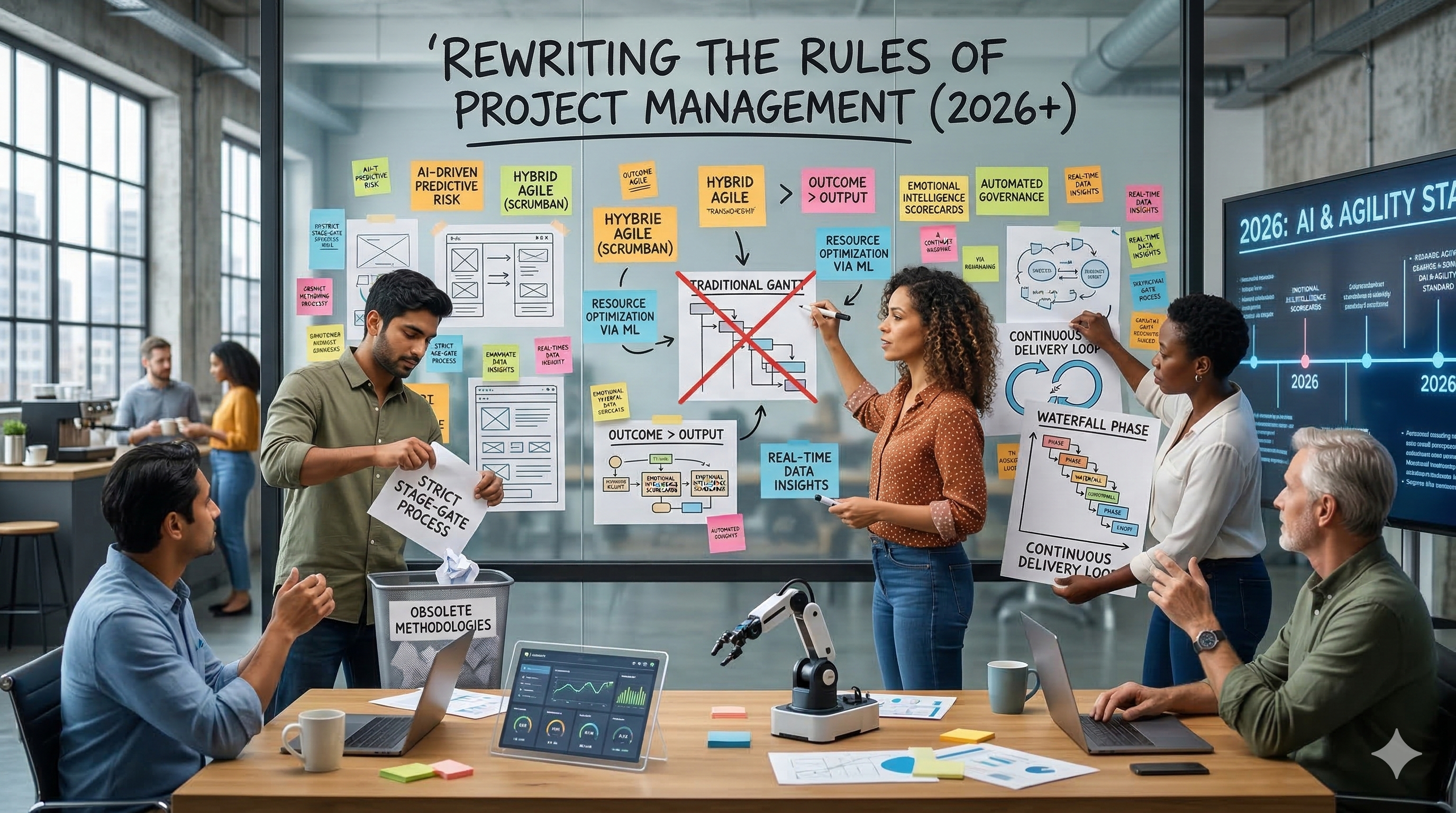
The final trend in this month's analysis is perhaps the one with the most immediate day-to-day impact for working project managers: human-centric forecasting. For decades, project scheduling has been dominated by static Gantt charts and waterfall timelines that treat tasks as fixed objects and people as interchangeable resources. The result has been a persistent, well-documented gap between the plan and the reality — a gap that project managers have papered over with contingency buffers, heroic effort, and Friday-afternoon replanning sessions.
The shift that has now become standard in 2026 is the move to dynamic, AI-reshuffled daily schedules that account for the full complexity of human resource availability. These systems pull from real-time data — calendar integrations, capacity signals, skill assessments, team sentiment indicators — and continuously reoptimize the task sequence and assignment logic to reflect what is actually possible on any given day. A team member who calls in sick, an unexpected client escalation, a dependency that resolves two days early — all of these are automatically factored into a living schedule that adjusts itself without requiring the project manager to manually rebuild the timeline from scratch.
What makes this "human-centric" rather than merely "AI-automated" is the design philosophy driving the best implementations. Rather than optimizing purely for delivery speed or resource utilization rates, the leading systems incorporate wellbeing signals, sustainable pace principles, and individual working-style preferences. They recognize that burning out a key technical lead to hit a sprint deadline is a false economy. The systems that have gained the most traction are those that project managers trust — and that trust is built when the AI's recommendations demonstrably account for the human dimension of project work, not just the mechanical task-sequencing logic.
Today's Strategic Insight
The four trends outlined in this edition of the March 2026 landscape are not independent phenomena — they are interlocking layers of a single, broader transformation. Agentic autonomy provides the execution muscle. Tactical governance provides the guardrails. GenOps provides the infrastructure agility. Human-centric forecasting provides the operational intelligence. Together, they describe a project management discipline that is faster, more adaptive, and more deeply integrated with AI than anything the profession has seen before.
The project leaders who will define the next decade are those who embrace this transformation with both ambition and discernment — who leverage AI's capabilities without surrendering the human judgment that remains irreplaceable. The question is no longer whether AI will reshape project management. It already has. The question now is whether your organization is shaping the AI, or letting the AI shape you.
"Build the governance before you need it. Set the rules before the agents run. The best time to define your AI project management strategy was last year. The second best time is today."