The Great Architectural Choice: Navigating the Divide Between Agentic and Pipeline AI in Software Delivery
The landscape of software delivery is undergoing a profound transformation. For years, the gold standard of engineering agility has been the automated pipeline—a predictable, step-by-step sequence designed to move code from development to production with minimal human intervention. However, a new paradigm is rapidly gaining traction, challenging the dominance of traditional automation. This shift is characterized by the rise of agentic artificial intelligence, a model that promises unprecedented velocity and adaptability. As organizations strive to modernize their agile workflows, they face a critical architectural decision: should they prioritize the rigid reliability of pipeline AI, or embrace the autonomous flexibility of agentic AI?
This choice is no longer a mere technical consideration; it has evolved into a strategic imperative. Recent industry analysis indicates that a significant portion of technology leaders now view this architectural decision as the primary lever for accelerating software delivery. The path an organization chooses will fundamentally shape its developer productivity, risk management strategies, and overall competitive advantage in an increasingly digital-first world.
The Predictability of Pipeline AI
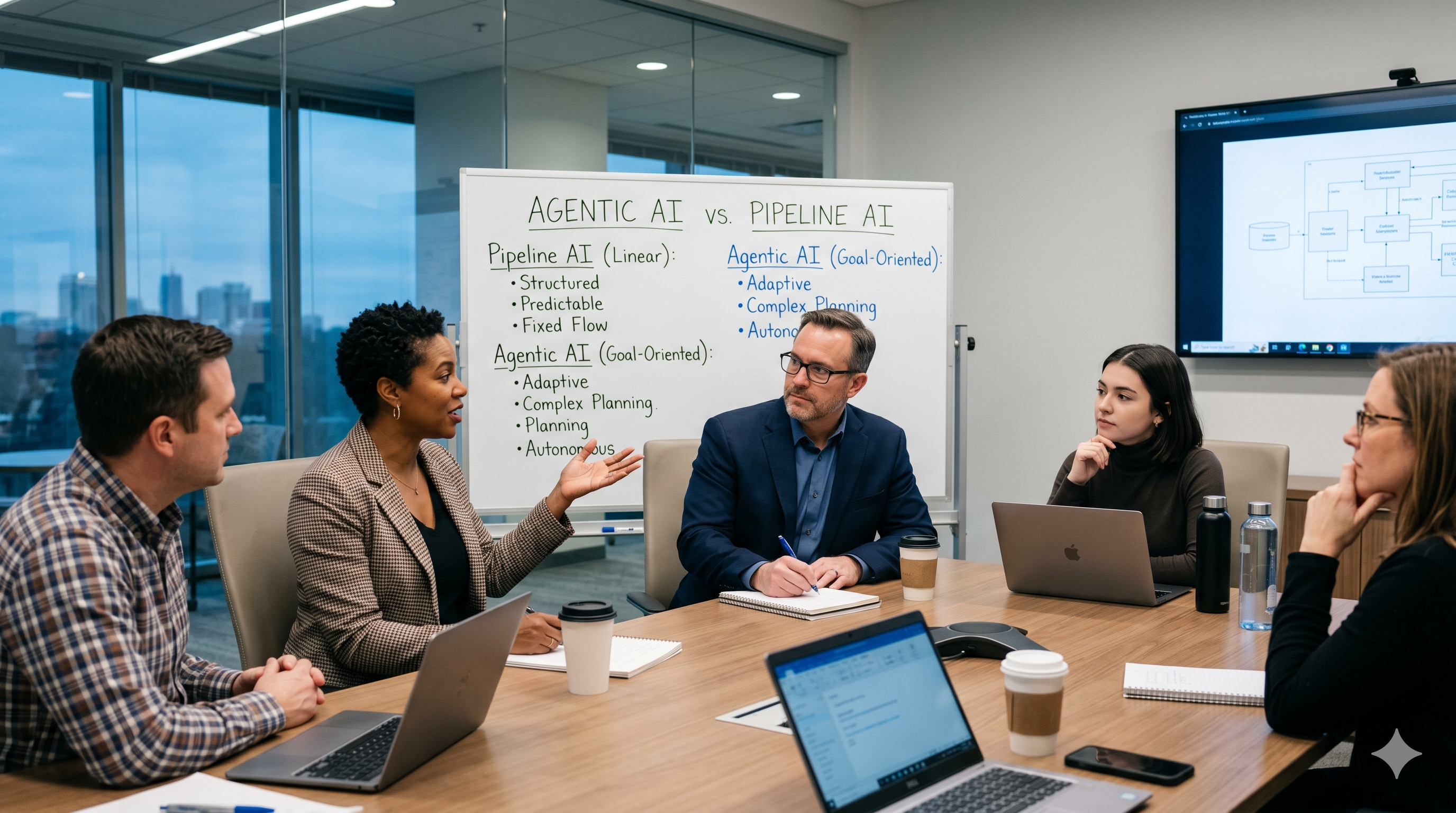
The pipeline model of artificial intelligence represents the evolution of traditional DevOps automation. It is designed around the concept of discrete, sequential steps. In a pipeline architecture, tasks such as code generation, testing, and security scanning are executed in a predetermined order, much like an assembly line. This approach is highly favored by enterprises that place a premium on governance, auditability, and strict risk controls.
The primary advantage of pipeline AI lies in its predictability. Because each step is isolated and auditable, organizations can easily track the flow of code and identify exactly where an issue occurred. This makes it significantly easier to integrate into compliance-heavy workflows and maintain rigorous security standards. For industries operating under strict regulatory frameworks, the pipeline model offers a comforting level of control and transparency.
However, this predictability comes with a notable trade-off. Pipeline AI systems are fundamentally reactive and lack the ability to understand broader contexts. They execute their programmed tasks efficiently but struggle to adapt to unexpected variables or complex, multi-repository dependencies. As software ecosystems become increasingly intricate, the incremental gains offered by pipeline automation may no longer be sufficient to drive transformative productivity improvements.
The Autonomy of Agentic AI
In contrast to the rigid structure of pipeline automation, agentic AI introduces a paradigm of autonomy and continuous learning. Rather than simply executing a predefined sequence of tasks, agentic systems are designed to reason, plan, and act intelligently across the entire software delivery chain. These systems can understand context, learn from past outcomes, and provide feedback that closely mimics the nuanced judgment of a senior software engineer.
The appeal of agentic AI lies in its remarkable flexibility and potential for high velocity. These autonomous agents can actively manage complex tasks, such as reviewing code for maintainability, predicting deployment failures, and autonomously optimizing build workflows. By treating software delivery as an adaptive ecosystem rather than a static process, agentic AI enables teams to move faster and tackle complex, multi-variable project bottlenecks with unprecedented efficiency.
Furthermore, agentic systems excel at identifying nuanced issues that traditional pipelines might miss. They can evaluate architectural decisions, prioritize technical debt, and ensure that every sprint aligns with broader business objectives. For organizations seeking to maximize developer productivity and accelerate innovation, the agentic model offers a compelling vision of the future.
Navigating the Trade-offs and Risks
While the promise of agentic AI is undeniable, it introduces new challenges that organizations must carefully navigate. The very autonomy that makes agentic systems so powerful also creates significant governance and reliability risks. When AI models are given the freedom to plan and act, the potential for unexpected behavior—such as hallucinations, drift from established guidelines, or the mishandling of edge cases—increases substantially.
Industry surveys reveal that security and risk concerns remain the top barriers to scaling agentic AI. As these systems take on greater autonomy, the consequences of failure grow more severe. Organizations can no longer concern themselves solely with an AI system generating incorrect code; they must also contend with the possibility of the system taking unintended actions or operating beyond appropriate guardrails.
To successfully leverage agentic AI, enterprises must establish robust foundations. This requires a fundamental shift in how trust and governance are approached. It is not enough to simply deploy autonomous agents; organizations must also implement comprehensive oversight structures, continuous monitoring, and clear accountability frameworks. The goal is to build a delivery ecosystem that moves fast but does so safely, ensuring that compliance is constant and risk is actively managed.
The Future of Software Delivery
The divide between pipeline and agentic AI is not necessarily an either/or proposition. The most successful organizations will likely be those that find a way to balance the predictability of pipelines with the intelligence of autonomous agents. The true differentiator in the coming years will not be raw model intelligence, but rather an organization's ability to control, monitor, and adapt AI behavior as requirements evolve.
As the software delivery landscape continues to shift, technology leaders must carefully evaluate their readiness for the agentic era. This involves auditing existing DevOps practices, strengthening security foundations, and cultivating a culture of responsible AI adoption. By doing so, organizations can unlock the full potential of artificial intelligence, transforming their software delivery processes into adaptive, self-improving systems that drive sustained business value.
The architectural choice between pipeline and agentic AI is a defining moment for modern enterprises. It requires a thoughtful approach that weighs the need for innovation against the imperative of control. Ultimately, the organizations that navigate this divide successfully will be the ones that redefine what efficiency, reliability, and agility mean in the age of artificial intelligence.