Beyond the Hype: Why 2026 is the Year of the Specialized, ROI-Driven AI Agent
The initial frenzy surrounding large language models (LLMs) is maturing into a more sophisticated and pragmatic phase of enterprise AI adoption. While the power of generative AI is undeniable, a significant strategic pivot is underway. Industry analysis and recent reports from late 2025 and early 2026 indicate that enterprises are moving away from generic, "one-size-fits-all" models and are instead embracing a new paradigm: the deployment of small, specialized, and ROI-driven AI agents, particularly in complex and regulated industries. This shift marks a critical inflection point where the abstract promise of AI is being replaced by a demand for tangible, measurable business results.
This evolution is driven by what can be described as an "ROI Awakening." Executive leaders, once captivated by the novelty of AI, are now demanding accountability. The consensus is clear: if an AI initiative cannot demonstrate a measurable impact on key performance indicators (KPIs)—such as reduced processing times, lower error rates, or direct cost savings—it is not considered ready for production environments [4]. This new focus on tangible value is forcing a fundamental rethink of how AI is developed, deployed, and managed within the enterprise.
The Strategic Shift to Vertical AI
The limitations of general-purpose LLMs become particularly apparent in specialized domains like healthcare, finance, and manufacturing. These sectors are governed by strict regulations, complex data, and the need for deep domain expertise. In response, the market is seeing a decisive move from horizontal AI—broad tools applied to common business processes—to vertical AI, which involves purpose-built agents designed to solve complex, industry-specific problems.
These specialized agents are not just a theoretical concept; they are already being deployed to great effect across various industries. As detailed by Databricks, these applications showcase the power of focused AI.
Industry | Specialized AI Agent Application | Business Impact |
Healthcare & Life Sciences | Diagnostic assistance, virtual clinical assistants | Accelerating diagnostic processes, personalizing patient care coordination |
Financial Services | Algorithmic trading bots, advanced fraud detection systems | Optimizing investment strategies, securing transactions in real-time |
Retail & Consumer Goods | Hyper-personalized recommendation engines, inventory management agents | Driving sales through tailored customer experiences, preventing stockouts |
Manufacturing & Transport | Supply chain optimization, autonomous route planning | Increasing logistical efficiency, reducing operational costs and delivery times |
This trend aligns with the prediction that by mid-2026, activating pre-built, embedded intelligence within core enterprise systems will be seen as a more prudent strategy than attempting to build everything from the ground up with generic models.
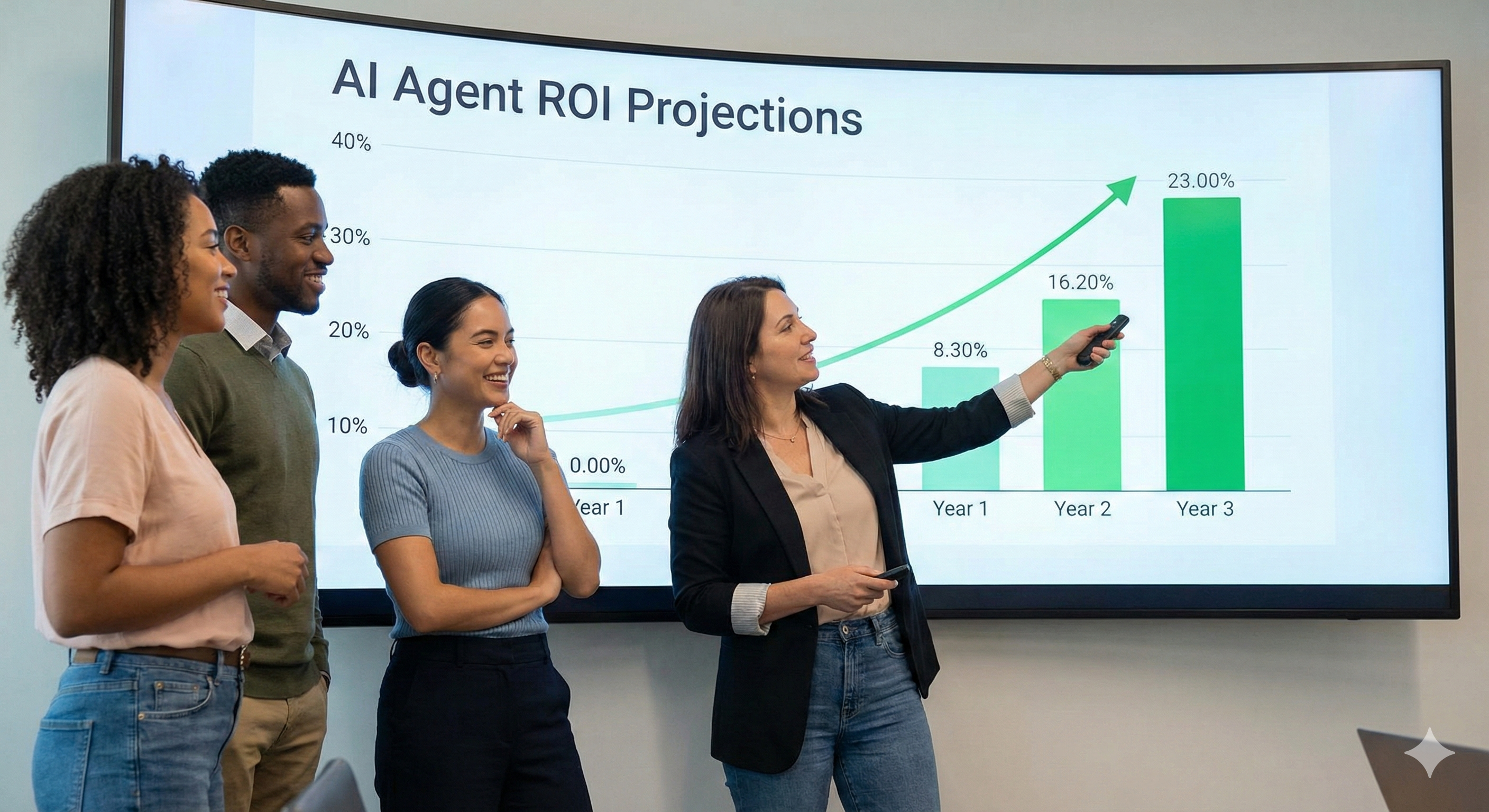
The ROI Awakening: A Reckoning for Enterprise AI
While executive confidence in the transformative power of AI remains remarkably high, a significant disconnect exists between this optimism and the operational reality of AI measurement and governance. A revealing 2026 report from Larridin, an AI measurement platform, highlights this paradox. The study found that while 92% of C-suite executives are confident in the impact of AI, a staggering 58% of their organizations report having no clear ownership for measuring AI performance, and 75% lack a formal AI governance framework.
This lack of oversight has led to a situation where nearly half of enterprise leaders admit they do not know who is using AI or how, despite expecting a return on their investment within six months [4]. The era of justifying AI projects based on potential or hype is over. The new mandate is clear and unforgiving: every agent's existence must be justified through concrete KPIs.
"The measure of success will no longer be how many AI pilots or agents you’ve built and launched. It will be your true adoption rate and how extensively your organization uses these agents. More critically, every agent’s existence will need to be justified through concrete KPIs."
This ruthless focus on measurement is what will separate the winners from the losers in 2026. Organizations are being advised to adopt a "consume-configure-build" hierarchy: first, activate pre-built agents embedded in existing applications; second, configure them for specific processes; and only then consider building a custom solution from scratch. This pragmatic approach ensures that resources are directed toward what genuinely works and delivers immediate, measurable value.
The Rise of the Agentic Enterprise and the Human-in-the-Loop
Concurrent with the demand for ROI is the emergence of the "Agentic Enterprise"—a collaborative ecosystem where humans and a multitude of specialized AI agents work in concert. A recent Salesforce report projects that the average number of AI agents used by organizations will surge by 67% by 2027, moving from the current average of 12 per organization.
However, the true transformation lies not in the number of agents, but in their orchestration. The most advanced enterprises in 2026 will leverage multi-agent orchestration as a core competitive weapon. This involves multiple specialized agents collaborating on complex workflows, with humans acting as a critical "quality control gate." This human-in-the-loop model preserves institutional knowledge and ensures that critical business judgment is applied to automated decisions, scaling human expertise rather than replacing it.
This collaborative model faces significant challenges, primarily a growing "orchestration and governance gap." The same Salesforce report found that while enterprises use an average of 957 applications, only 27% of them are integrated, and 50% of AI agents operate in isolated silos. This fragmentation creates disconnected workflows, redundant automation, and increases the risk of "shadow AI," where ungoverned AI usage introduces security and compliance risks.
To bridge this gap, 94% of IT leaders agree that success with AI will require a more API-driven architecture, creating a unified foundation to connect, govern, and orchestrate a multi-agent workforce securely and effectively.
Conclusion: The Path to Intelligent Transformation
The future of enterprise AI is not about a single, monolithic intelligence. It is about building a dynamic, collaborative ecosystem of specialized agents that are held accountable for delivering real-world value. The shift from generic LLMs to a portfolio of purpose-built, ROI-driven agents represents a significant maturation of the market.
The enterprises that will thrive in 2026 and beyond will be those that move past experimentation and embrace this new reality. They will build a practical competitive advantage by orchestrating intelligence directly within the workflows that drive revenue and efficiency, all while empowering their human workforce to provide the final layer of judgment and value. The question is no longer if AI agents will transform your industry—they will. The question is whether you will lead that transformation or be forced to play catch-up.