Beyond Chatbots: How GitLab Duo is Ushering in the Agentic Era
The software development landscape is on the cusp of its most significant transformation yet. For the past few years, AI coding assistants have been the talk of the town, promising to accelerate developer productivity. While they’ve delivered on that promise to an extent, their impact has been largely confined to the coding phase, a mere fraction of the entire software development lifecycle (SDLC). This has created what many are calling the "AI paradox": faster coding leads to new bottlenecks in code reviews, security, and testing. Today, with the general availability of the GitLab Duo Agent Platform, GitLab is making a bold statement: the era of the simple AI assistant is over. The age of the AI agent has begun.
The News: An Orchestra of Agents
Announced on January 15, 2026, the GitLab Duo Agent Platform, now generally available with GitLab version 18.8, is not just another AI chatbot. It is a comprehensive, agentic AI platform designed to orchestrate and automate tasks across the entire SDLC
. Instead of a single, general-purpose assistant, GitLab introduces a team of specialized “Foundational Agents,” each an expert in its domain, ready to collaborate with human developers and project managers.
| Foundational Agent | Key Capabilities |
| Planner Agent | Structures, prioritizes, and breaks down work. Creates epics, issues, and generates acceptance criteria. |
| Security Analyst Agent | Triages vulnerabilities, identifies false positives, explains impact, and prioritizes security risks. |
| Data Analyst Agent | Queries and visualizes data across the GitLab platform to provide actionable insights on projects and teams. |
Unlike standard AI coding assistants that are limited to code generation, these Foundational Agents possess multi-step reasoning capabilities and can perform autonomous actions with full lifecycle context. They operate within an organization's existing standards and guardrails, moving beyond simple code suggestions to active participation in planning, security, and analysis
The Impact: Redefining Daily Workflows
The introduction of orchestrated autonomy is set to fundamentally change the daily routines of both developers and project managers.
For developers, the promise is a significant reduction in toil and a renewed focus on high-value, creative work. The platform’s Agentic Chat, available in the IDE and GitLab’s web UI, acts as a true collaboration partner. It can explain unfamiliar code, generate tests, fix bugs, and even modernize entire pipeline configurations. The “Fix CI/CD pipeline” flow, for instance, can autonomously analyze failures, identify root causes, and prepare recommended changes, turning a potentially hours-long debugging session into a quick review and approval This moves the developer from a 'doer' of tedious tasks to an 'overseer' of automated workflows.
For project managers, the benefits are equally profound. The Planner Agent automates the administrative overhead of breaking down large initiatives into manageable tasks, creating a clearer, more actionable project plan from the outset. This allows project managers to spend less time on manual ticket creation and more time on strategic oversight and stakeholder communication. With the platform providing visibility into how agents are being used and their contribution to work, leaders can measure the impact of AI adoption and ensure it aligns with business goals
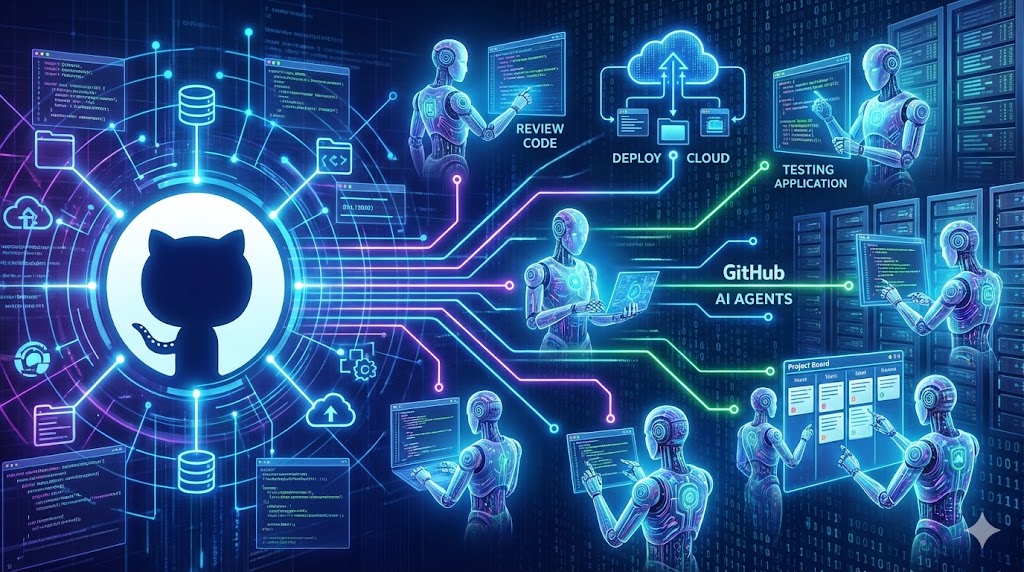
The Bigger Picture: The Dawn of the AI Control Plane
GitLab's move signals a crucial shift in the industry, addressing the growing need for governance in an increasingly automated world. As one industry analyst from the Futurum Group noted, “Agent-driven execution is advancing faster than enterprise approval models. Platforms that cannot clearly assert where control lives will face resistance as automation spreads”
GitLab is positioning itself as an “AI orchestration plane,” where humans and agents share responsibility for delivery within a governed framework. By embedding control directly into the delivery system—tying agent actions to work items, pipelines, and security context—GitLab ensures that every automated action is traceable, auditable, and compliant. The introduction of the AI Catalog, a central repository for managing approved agents and workflows, further reinforces this commitment to governed automation.
This approach is a direct challenge to other models where AI is either a siloed add-on or a free-for-all. As IDC forecasts that 70% of organizations will embed AI agents into their DevOps pipelines by 2030, the ability to orchestrate these agents within a trusted, controlled environment will become the key differentiator.
Conclusion: A New Collaborative Paradigm
The general availability of the GitLab Duo Agent Platform is more than just a product launch; it's a declaration of a new paradigm for software development. By moving beyond simple AI assistance to a model of orchestrated autonomy, GitLab is tackling the AI paradox head-on. The platform empowers developers and project managers to delegate, not just automate, freeing them from the mundane to focus on what humans do best: innovate.
As Bal Kang, an engineering platform lead at NatWest, stated, “The agents have become true collaborators to our teams”. This vision of human-agent collaboration, built on a foundation of trust, governance, and shared context, is not a distant future—it’s here. And with it, the promise of not just faster coding, but accelerated innovation at scale.
References
[1] Announcing general availability for GitLab Duo Agent Platform
[2] Understanding agents: Foundational, custom, and external
[3] GitLab Delivers on AI Agents Promise to Automate DevOps Workflows
[4] GitLab Announces the General Availability of GitLab Duo Agent Platform
[5] GitLab’s Salvo in the Agent Control Plane Race